A great kids’ party isn’t about doing more — it’s about doing the right things, in the right order. The difference between a magical afternoon and a chaotic one is almost always pacing. Get the schedule right and the energy stays high without tipping into meltdown territory. Get it wrong and you’ll be wrangling overstimulated 6-year-olds while the cake sits forgotten.
This guide gives you a tested hour-by-hour schedule used at hundreds of children’s birthday parties in Hong Kong. Adjust the timing for younger or older kids, but the shape stays the same.
Why Pacing Matters More Than Activities
Most parents over-plan their kids’ parties. They book a bouncy castle, a face painter, a magician, a craft station, and pizza — and then watch the day collapse under its own weight. Kids get tired. Things run late. The cake gets eaten before the show. Someone cries.
The fix isn’t more activities — it’s a clear arc: a calm arrival, a high-energy middle, a peak moment (cake + magic), and a graceful goodbye. Kids’ attention follows that curve naturally. Fight it and the party loses.
The Ideal Length
For most birthday parties:
- Ages 2–4: 1.5 to 2 hours
- Ages 5–8: 2 to 2.5 hours
- Ages 9–12: 2.5 to 3 hours
Anything longer and the energy crashes. Anything shorter and parents feel rushed. Two hours is the sweet spot for the most common 5–8 age group, and it’s the timeline we’ll use below.
The Hour-by-Hour Schedule (2-Hour Party)
Let’s say your party runs 3:00 PM to 5:00 PM. Here’s the full shape at a glance:
| Time | Duration | Block | The job of this block |
|---|---|---|---|
| 2:45 PM | 15 min | Final setup | Last details before guests arrive |
| 3:00 PM | 20 min | Arrival & settle-in | Absorb staggered arrivals with a welcome activity |
| 3:20 PM | 25 min | Free play & light games | Burn arrival energy, let friendships form |
| 3:45 PM | 45 min | Magic show (main event) | The peak — focused, seated, calm |
| 4:30 PM | 15 min | Cake & singing | The emotional high point |
| 4:45 PM | 15 min | Food, loot bags, goodbyes | Cool-down and graceful exit |
The detail for each block follows.
2:45 PM — Final Setup
Last 15 minutes before kids arrive:
- Balloons up, tables set
- Music on (low volume, upbeat playlist)
- A welcome activity ready at the door — colouring sheets, stickers, a small craft
- Designated “welcome adult” (you or a helper) at the entrance
The welcome activity matters more than parents expect. It absorbs the awkward 10–15 minutes of staggered arrivals and prevents the “all the kids run wild while we wait for the late ones” problem.
3:00 – 3:20 PM — Arrival and Settle-In
Kids trickle in. Parents drop off or stay. Coats and shoes go in a marked area. Each child joins the welcome activity at the door.
Tip: don’t start any formal activity in this window. Some kids will be 10 minutes late. If you start games at 3:05, half the guests miss the start and the host parent spends the next 30 minutes re-explaining the rules.
3:20 – 3:45 PM — Free Play and Light Games
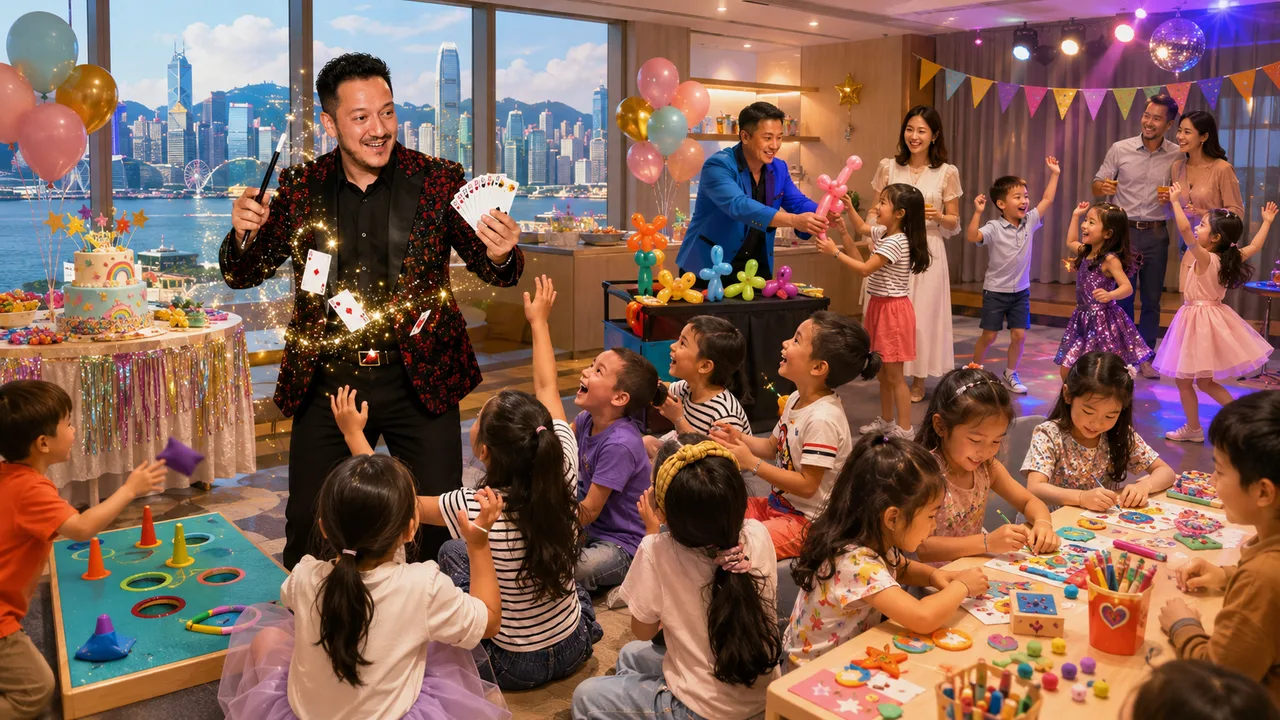
Kids are now mostly all in. Run gentle, low-stakes games that don’t require everyone to be present from the start — musical statues, parachute, a quick treasure hunt. The goal is to burn off arrival energy and let friendships form.
Avoid competitive elimination games at this point. You don’t want any child sitting out within the first 30 minutes of their friend’s birthday.
3:45 – 4:30 PM — The Main Event: Magic Show
This is the peak. Sit the kids on the floor in a semi-circle, parents at the back, lights as bright as possible. A professional children’s magic show runs 40 to 60 minutes and includes:
- Audience participation for multiple kids
- Comedy and surprise
- A personalized moment for the birthday child
- Often a balloon-twisting segment or a live bunny appearance
- A clean, controlled ending that flows naturally into cake-cutting
Why magic works here: kids are seated, attention locked on one focal point, and the energy turns inward instead of bouncing off the walls. They emerge calm, happy, and ready for cake — exactly the state you want before sugar enters the equation. If you’ve ever wondered why a magic show beats other party entertainment, this is part of the answer.
4:30 – 4:45 PM — Cake and Singing
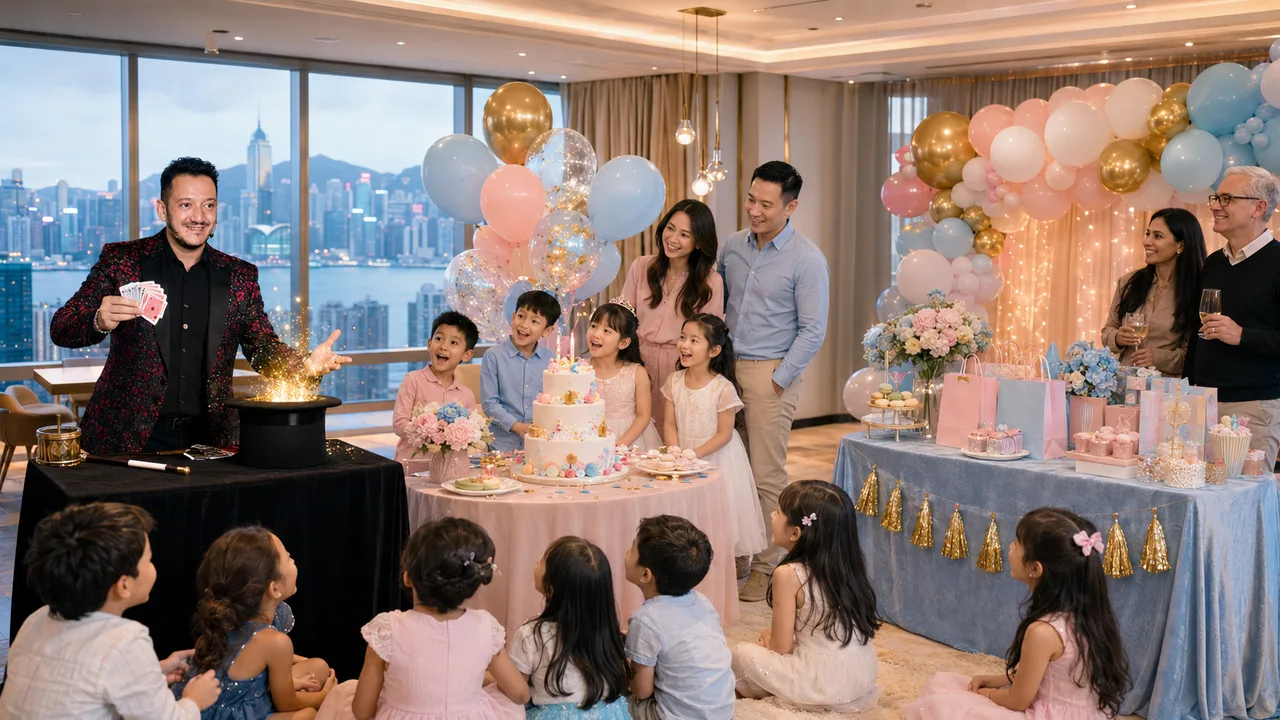
Right after the magic show is the moment. Kids are warm, energized, and emotionally connected. Bring out the cake, dim the lights for the candles, sing, take photos, cut the cake.
A good magician will often help host this transition — calling everyone to gather, leading the song, building the moment up.
4:45 – 5:00 PM — Food, Loot Bags, and Goodbyes
This is the cool-down. Kids eat cake at the table (slows them down, prevents sticky chaos). Parents start arriving. Loot bags go out at the door as kids leave with a “thank you for coming” from the birthday child.
By 5:00 PM, you’re done. Two hours, well-paced, with a clear emotional peak.
Variations for Different Ages
Ages 3–4 (90-minute party)
Compress the schedule. Skip games — toddlers don’t play structured games well. Replace with:
- 20-min arrival + free play
- 30-min magic show (a 30 to 40-minute show is plenty for this age)
- 15-min cake
- 25-min cool-down with snacks and quiet play
Ages 9–12 (2.5 to 3-hour party)
Stretch the middle. Older kids handle longer activity blocks and want more autonomy:
- 30-min arrival + greeting
- 30-min structured activity (escape room, scavenger hunt, sports)
- 60-min magic show (a longer premium format works for this age — they can sit longer and engage more)
- 15-min cake
- 30-min cool-down, sometimes a movie or chill zone
Common Pacing Mistakes
Cake first
Never start with cake. The sugar spike hits in 20 minutes and you’ll be running a sugar-rush gladiator pit by the time the magic show starts.
Two big events back-to-back
A bouncy castle followed immediately by a magic show is a recipe for restless kids who can’t sit still. Big-energy and focused-energy activities don’t pair well — choose one centerpiece.
Open buffet from the start
Food available the whole party means kids graze instead of eat, get sticky hands, and lose energy at unpredictable times. Cluster food into one or two clear windows.
No buffer time
If your magic show is booked for 45 minutes, don’t schedule the cake at minute 46. Build 5–10 minutes of buffer between major activities — kids need transitions.
The “Schedule on a Card” Method
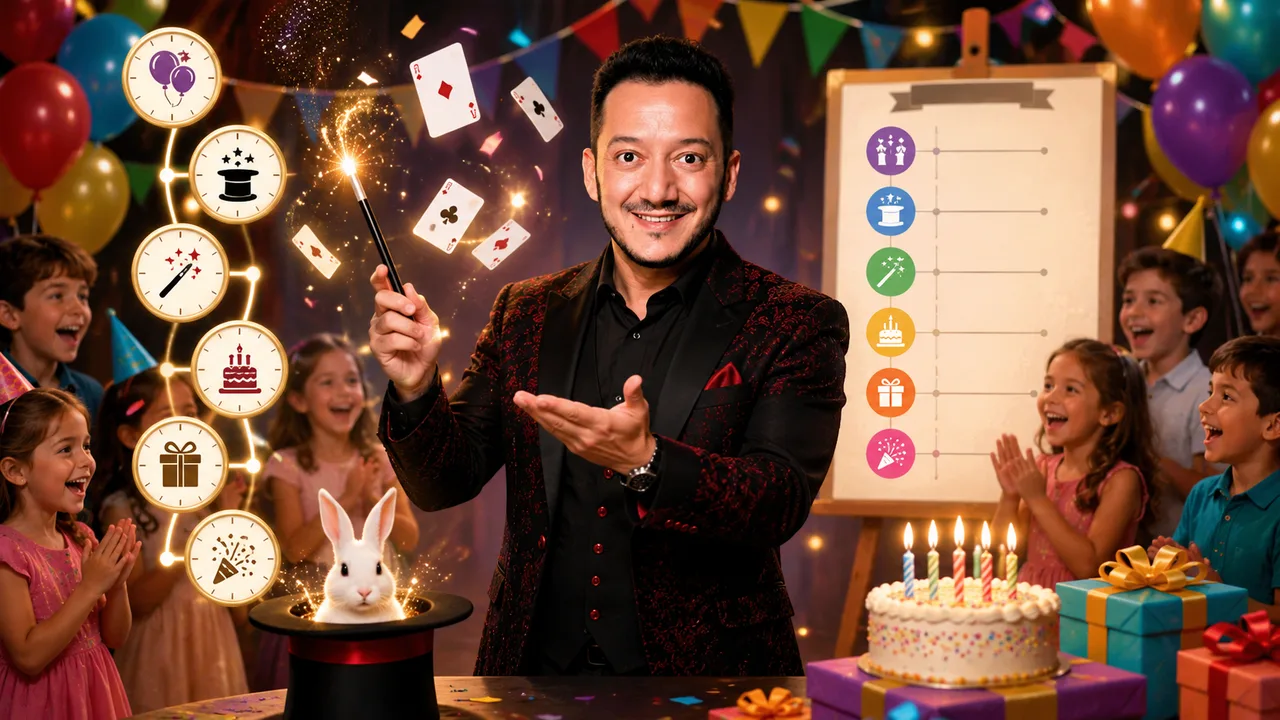
Print your schedule on a single 4x6 card and tape it to the fridge. Share it with the magician, your partner, and any helpers. The card has just:
- Start and end times
- The 3 or 4 key moments (arrival, main event, cake, goodbye)
- One bullet under each
When the party is happening and you have one eye on the clock and one eye on twenty 6-year-olds, that card keeps everyone aligned.
Common Questions Parents Ask
What if some kids arrive 20 minutes late?
That’s why arrival is a 20-minute soft window with a welcome activity. The structured part doesn’t start until everyone is settled.
Should the magic show come before or after the cake?
Before. Always before. The show focuses the kids; the cake celebrates them. Reversing the order means you cut into a sugar spike.
Do parents stay or leave?
Up to you. For ages 3–5, most parents stay. For 6+, most drop off. Either way, set the expectation clearly in the invitation so you know your headcount.
How do I keep older siblings entertained?
A good magician keeps a wide age range engaged for the whole show. For other moments, give older siblings a small role — manning the welcome table, helping serve cake, or holding the birthday child’s hand for the candles.
Two hours, four clear blocks, one peak moment. That’s all a great party needs.
See our birthday packages for the magic-show part of your schedule, or get in touch to talk through your plan.